Streaming Deep Dive
Kafka, Spark Structured Streaming, Flink and the streaming patterns that come up in nearly every senior data engineering loop.
Kafka Fundamentals
Core Concepts
| Concept | Description |
|---|---|
| Topic | Category/feed of messages |
| Partition | Ordered, immutable sequence within a topic |
| Offset | Position of a message within a partition |
| Consumer Group | Set of consumers sharing the work of reading a topic |
| Broker | Kafka server that stores data |
Partitioning
Topic: orders (6 partitions)
┌────────────┬────────────┬────────────┐
│ Partition 0│ Partition 1│ Partition 2│
│ user_1     │ user_2     │ user_3     │
│ user_7     │ user_8     │ user_9     │
└────────────┴────────────┴────────────┘
┌────────────┬────────────┬────────────┐
│ Partition 3│ Partition 4│ Partition 5│
│ user_4     │ user_5     │ user_6     │
│ user_10    │ user_11    │ user_12    │
└────────────┴────────────┴────────────┘
Partition Key Choices:
| Key | Ordering Guarantee | Risk |
|---|---|---|
user_id | All events for a user in order | Hot users cause skew |
null (round-robin) | None | Even distribution |
event_type | Events of same type in order | Uneven if types vary |
Sizing Rules
Partitions = max(
    desired_throughput / throughput_per_partition,
    num_consumers_in_group
)

# Example: 100K msg/sec, each partition handles 10K/sec
# Partitions = max(100K/10K, 20 consumers) = max(10, 20) = 20
Retention
| Strategy | Use Case |
|---|---|
| Time-based (7 days) | Standard: replay window |
| Size-based (100GB) | When storage constrained |
| Compacted | Keep latest per key (changelogs) |
Delivery Semantics
At-Most-Once
- Fire and forget
- May lose messages
- Use: Metrics where loss is okay
At-Least-Once
- Retry until ack
- May duplicate messages
- Use: Most pipelines (with dedup)
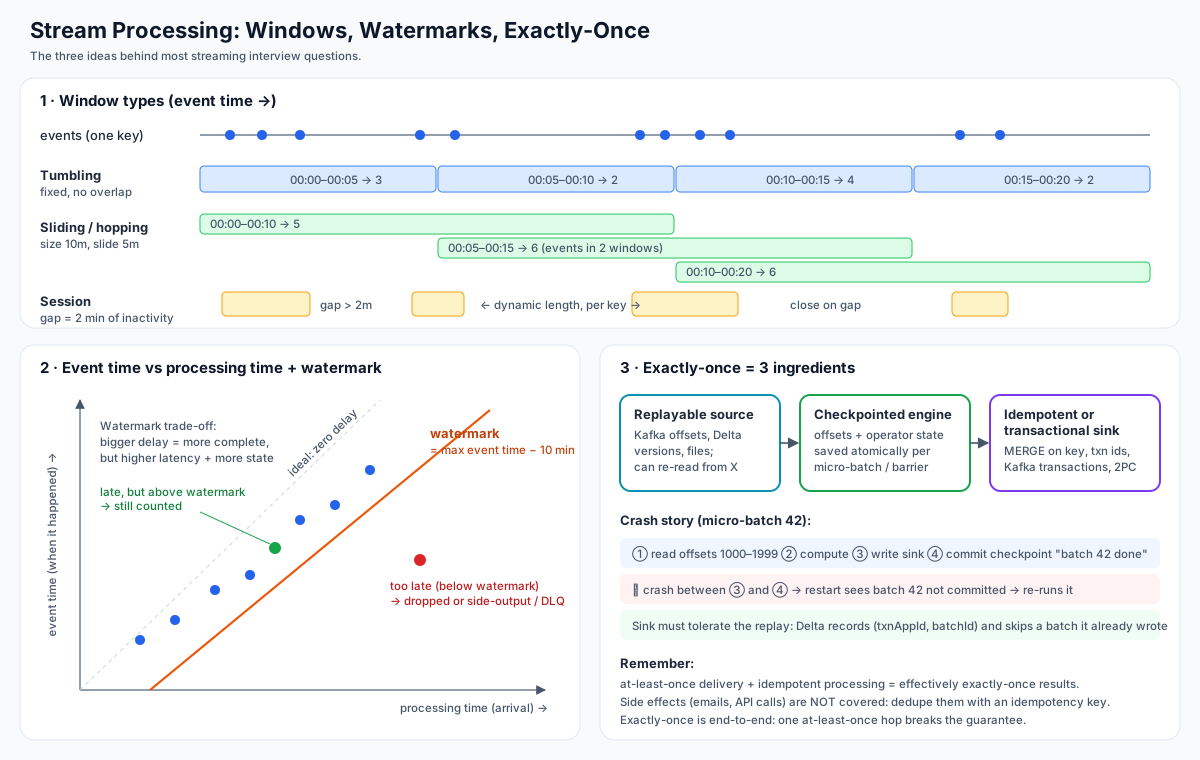
Exactly-Once
- No loss, no duplicates
- Requires: Idempotent producers + transactional consumers
- Use: Financial, billing
How to Achieve Exactly-Once:
# Kafka producer
producer = KafkaProducer(
    enable_idempotence=True,  # Prevents duplicates on retry
    transactional_id="my-txn-id"  # Enables transactions
)

# Spark consumer
spark.readStream \
    .format("kafka") \
    .option("kafka.isolation.level", "read_committed")  # Only committed txns
Windowing
Tumbling Window
Fixed, non-overlapping intervals.
Events: [1, 2, 3, 4, 5, 6, 7, 8, 9]
Window: 3 events
Result: [1,2,3], [4,5,6], [7,8,9].groupBy(window("timestamp", "5 minutes"))Sliding Window
Overlapping intervals.
Events: [1, 2, 3, 4, 5]
Window: 3, Slide: 1
Result: [1,2,3], [2,3,4], [3,4,5].groupBy(window("timestamp", "10 minutes", "2 minutes")) # 10min window, 2min slideSession Window
Gap-based, ends after inactivity.
Events: [1, 2, 3, --gap--, 7, 8, --gap--, 15]
Gap: 3
Result: [1,2,3], [7,8], [15].groupBy(session_window("timestamp", "30 minutes")) # Spark 3.2+Watermarks & Late Data
What is a Watermark?
A watermark says: “I believe I’ve seen all events with timestamp <= W”
df.withWatermark("event_time", "10 minutes")This means: Allow events up to 10 minutes late. Later events are dropped.
Handling Late Data
| Strategy | Implementation |
|---|---|
| Drop late events | Default with watermark |
| Emit late to separate sink | outputMode("update") + side output |
| Reprocess in batch | Daily reconciliation job |
# Late data to separate stream (Flink)
late_data = windowed_stream.getSideOutput(late_output_tag)
Spark Structured Streaming
Basic Pattern
# Read
df = spark.readStream \
    .format("kafka") \
    .option("subscribe", "topic") \
    .option("startingOffsets", "latest") \
    .load()

# Transform
result = df.select(from_json(col("value"), schema).alias("data")) \
    .select("data.*") \
    .withWatermark("timestamp", "5 minutes") \
    .groupBy(window("timestamp", "1 minute")) \
    .count()

# Write
query = result.writeStream \
    .format("delta") \
    .outputMode("append") \
    .option("checkpointLocation", "/checkpoint") \
    .trigger(processingTime="30 seconds") \
    .start()
Output Modes
| Mode | Behavior | Use Case |
|---|---|---|
| Append | Only new rows | Non-aggregated output |
| Update | Changed rows only | Aggregations to KV store |
| Complete | Full result table | Aggregations to file (small) |
Triggers
| Trigger | Behavior |
|---|---|
processingTime="10 seconds" | Micro-batch every 10s |
once=True | Single batch, then stop |
availableNow=True | Process all available, then stop |
continuous="1 second" | True streaming (experimental) |
Flink vs Spark Streaming
| Aspect | Spark Streaming | Flink |
|---|---|---|
| Model | Micro-batch | True streaming |
| Latency | Seconds-minutes | Milliseconds |
| State | In-memory + checkpoint | RocksDB + checkpoint |
| CEP | Limited | First-class |
| Exactly-once | With checkpoints | Native |
| Batch | Excellent | Good |
When to Use Flink
- Sub-second latency required
- Complex event processing (fraud patterns)
- Large state (>100GB)
When to Use Spark Streaming
- Team knows Spark
- Delta Lake integration
- Batch + streaming on same code
- Latency >10s is acceptable
State Management
Stateless vs Stateful
| Type | Example | Complexity |
|---|---|---|
| Stateless | Filter, map, project | Easy |
| Stateful | Aggregation, join, dedup | Hard |
State Backends
| Backend | Use Case |
|---|---|
| In-memory (Spark) | Small state, fast |
| RocksDB (Flink) | Large state, persistent |
State Cleanup
# Spark: State expires with watermark
df.withWatermark("timestamp", "1 hour")  # State cleared after 1 hour

# Flink: Explicit TTL
descriptor.enableTimeToLive(StateTtlConfig.newBuilder(Time.hours(1)).build())
Checkpointing
Periodic snapshots of state for fault tolerance.
# Spark
.option("checkpointLocation", "/checkpoints/my_job")

# Flink
env.enableCheckpointing(60000)  # Every 60 seconds
env.getCheckpointConfig().setCheckpointStorage("s3://bucket/checkpoints")
Recovery
On failure, restart from last checkpoint. Reprocess events since checkpoint.
Checkpoint vs Savepoint (Flink)
- Checkpoint: Automatic, for recovery
- Savepoint: Manual, for upgrades/migrations
Common Patterns
Deduplication
# Spark: Dedupe within watermark window
df.withWatermark("timestamp", "10 minutes") \
  .dropDuplicates(["event_id", "timestamp"])

# Alternative: Use Delta MERGE with event_id as key
Stream-Stream Join
# Join two streams within time range
left.withWatermark("time", "10 minutes") \
    .join(
        right.withWatermark("time", "10 minutes"),
        expr("left.key = right.key AND left.time BETWEEN right.time - interval 5 minutes AND right.time + interval 5 minutes")
    )
Stream-Static Join (Enrichment)
# Join streaming events with static dimension
events.join(broadcast(dim_product), "product_id")
References
Stream-stream join: how state is bounded
sequenceDiagram
    participant I as impressions stream
    participant J as join operator (state store)
    participant C as clicks stream
    I->>J: impression ad=7 t=10:00 (buffered)
    C->>J: click ad=7 t=10:03
    J-->>J: match within 0-15 min interval
    Note over J: emits joined row
    Note over J: watermark passes 10:15 + delay, so impression state is evicted
imps   = impressions.withWatermark("imp_ts", "10 minutes")
clicks = clicks.withWatermark("click_ts", "20 minutes")
joined = imps.join(
    clicks,
    expr("""click_ad_id = imp_ad_id AND
            click_ts >= imp_ts AND
            click_ts <= imp_ts + interval 15 minutes"""),
    "leftOuter")          # outer joins REQUIRE watermarks + time bounds
Without watermarks and a time-range condition, the engine must keep both sides forever, and state grows without bound.
Interview questions
Your streaming job's state store keeps growing until executors OOM. What do you check?
- Is there a watermark on every stateful operator (aggregations, dedup, stream-stream joins)? 2. Do joins have a time-range bound? 3. Is the key cardinality unbounded (e.g. grouping by session_id with no window)? 4. Use RocksDB state store instead of in-memory (HDFS-backed) for large state. 5. For arbitrary stateful processing, set state TTL / timeouts. 6. Watch the
stateOperators.numRowsTotaland memory metrics in the streaming query progress.
How do you deduplicate a stream exactly?
Pick a unique event id. dropDuplicatesWithinWatermark("event_id") with a watermark bounded by the max expected duplicate delay; plus an idempotent sink (MERGE on event_id) to catch anything older than the watermark. Without a watermark, dropDuplicates keeps every id forever.
Checkpoint vs savepoint vs Delta transaction log?
Checkpoint: automatic, engine-owned snapshot of offsets + state for failure recovery. Savepoint (Flink): user-triggered, portable snapshot for upgrades/migrations/rescaling. Delta log: the sink table’s own commit history; Structured Streaming also writes (appId, batchId) there so replays don’t double-write.
Kafka consumer lag is growing steadily. Walk through your diagnosis.
Is input rate up (traffic spike) or processing rate down (slower batches)? Check batch duration vs trigger interval, skewed partitions (one partition lagging = hot key), GC/OOM, slow sinks (DB backpressure), external lookups per record. Fixes: scale executors / partitions (if parallelism is capped by partition count, add partitions carefully), salt hot keys, batch external calls, tune maxOffsetsPerTrigger, optimise the sink.