Design an Enterprise RAG Knowledge Assistant
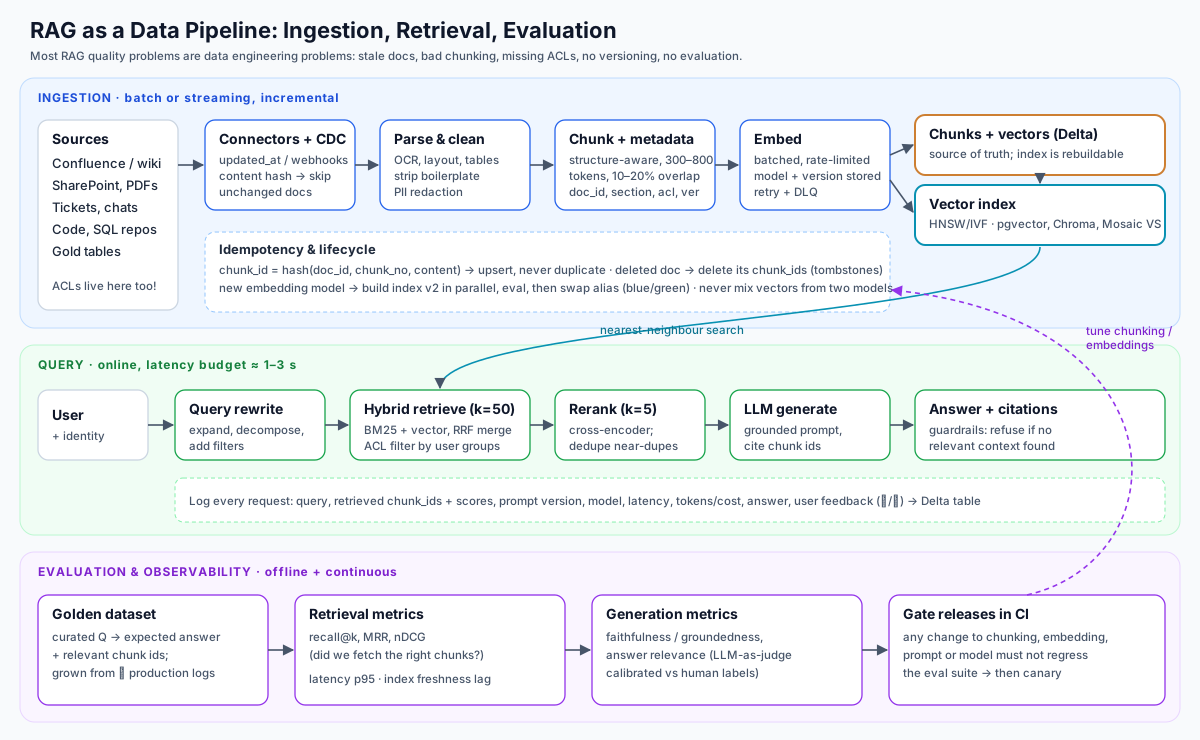
Problem
Employees should be able to ask questions in natural language and get answers grounded in internal knowledge: Confluence, SharePoint, Google Drive, Jira, Slack, PDFs. Answers must cite sources and only use documents the asking user is allowed to see. Design the system with a focus on the data pipelines.
Clarifying questions
| Question | Assumed answer |
|---|---|
| Corpus size? | 5 M documents, ~50 M chunks; 2% change per day |
| Users / QPS? | 50k employees, peak 50 queries/s |
| Latency? | First token < 2 s, full answer < 8 s |
| Freshness? | Edits visible within 15 minutes; permission changes within 5 minutes |
| Languages? | English + German + Japanese |
| Hosting constraints? | LLM via a cloud provider in-region; no training on company data |
1. Estimates
Chunks: 50M × 1024-dim float32 (4 KB) = 200 GB vectors → + HNSW overhead ≈ 300 GB RAM
  → int8 quantisation ≈ 75 GB, or sharded index across nodes
Daily changes: 2% × 5M = 100k docs → ~1M chunks re-embedded/day → ~500M tokens/day → tens of $/day
Initial embedding: 50M chunks × 500 tokens = 25B tokens → one-off, hundreds of $; rate limits dominate time (days)
Query: 50 QPS × (retrieve 50 + rerank + LLM ~4k input tokens) → LLM cost dominates: budget per query
2. Architecture
flowchart LR
    subgraph Connectors
        C1[Confluence]
        C2[SharePoint / Drive]
        C3[Jira / Slack]
    end
    C1 --> Q[[Change queue<br/>webhooks + periodic crawl]]
    C2 --> Q
    C3 --> Q
    Q --> FETCH[Fetch + raw store<br/>bronze: original files]
    FETCH --> PARSE[Parse, clean, PII redact<br/>layout-aware]
    PARSE --> CHUNK[Chunk + metadata<br/>doc_id, section, acl, lang, updated_at]
    CHUNK --> DIFF{chunk hash changed?}
    DIFF -->|yes| EMB[Embedding workers<br/>batched, rate-limited]
    DIFF -->|no| SKIP[skip]
    EMB --> CT[(silver.chunks: text, vector,<br/>metadata, model_version)]
    CT --> VI[(Vector + BM25 index<br/>synced from table)]
    ACL[ACL sync service<br/>group memberships, doc permissions] --> CT
    ACL --> VI
    U[User + SSO identity] --> API[Assistant API]
    API --> VI
    API --> RR[Reranker]
    API --> LLM[LLM]
    API --> LOG[(llm_ops.requests)]
    LOG --> EVAL[Eval pipelines + dashboards]
3. Deep dives
3.1 Incremental ingestion
- Change detection: webhooks where available (near real time), plus periodic crawls (with
modified_since) and weekly full reconciliation to catch missed events and deletions. - Bronze keeps the raw file (re-parse when the parser improves, without re-downloading).
chunk_id = hash(doc_id, chunk_index, chunk_text): unchanged chunks keep their embeddings; changed docs re-embed only changed chunks; removed chunks are deleted.- Embedding workers pull from a queue, batch requests (e.g. 100 chunks), respect rate limits with token buckets, retry with backoff, DLQ for persistent failures. Idempotent upserts by chunk_id.
3.2 Permissions (the make-or-break requirement)
flowchart LR
    DOCP[Doc permissions<br/>from source APIs] --> NORM[Normalise to principal ids<br/>users + groups]
    GRP[IdP group memberships] --> EXP[(user → groups<br/>cache, 5-min refresh)]
    NORM --> META[chunk.acl = list of principal ids]
    Q[Query from user] --> EXP
    EXP --> FILTER["Retrieval filter:<br/>chunk.acl ∩ user principals ≠ ∅"]
    META --> FILTER
- Store ACLs as metadata on each chunk; pre-filter in the vector search (not post-filter: post-filtering top-50 might leave 0 results and leaks timing/side channels).
- Permission changes propagate via ACL sync without re-embedding (metadata-only update).
- Group explosion (users in 500 groups): store group ids on chunks, expand user → groups at query time.
- Audit log: which chunks were shown to which user.
3.3 Retrieval quality
- Hybrid search (BM25 + dense, reciprocal rank fusion): crucial for ticket ids, error codes, product names.
- Query rewriting: conversation-aware (resolve “what about for Japan?” using chat history), multilingual (multilingual embeddings or translate query).
- Rerank top 50 → top 5–8 with a cross-encoder.
- Metadata boosts/filters: recency for fast-changing content, space/project filters, document type.
- Chunking: structure-aware for Confluence/Markdown (by headings, keep section path as context), tables kept intact, parent-child retrieval for long docs.
3.4 Evaluation & monitoring
| What | How |
|---|---|
| Retrieval recall@k | Golden set: 500 questions with known relevant docs (from SMEs + mined from search logs) |
| Faithfulness / citation correctness | LLM judge + human spot checks weekly |
| Freshness | now − source.updated_at for recently edited docs, end-to-end ingestion lag |
| ACL correctness | Synthetic test users with known permissions; automated leakage tests in CI |
| Cost & latency | Per request logs; budget alerts |
| User feedback | 👍/👎 + “wrong source” flags → triage queue → golden set growth |
Every change (chunker, embedding model, prompt, reranker) runs the eval suite before rollout; embedding model changes use blue/green indexes.
4. Trade-offs
| Decision | Choice | Alternative |
|---|---|---|
| Source of truth | Delta chunks table; index derived | Vector DB as the only store (hard to rebuild/audit) |
| ACL enforcement | Pre-filter in retrieval | Post-filter, or separate index per group (explodes) |
| Embedding model | Multilingual, 768–1024 dims, quantised | Larger dims (cost/RAM), per-language models (complexity) |
| Freshness | Webhooks + crawl + reconcile | Nightly full re-index (stale, costly) |
5. Failure modes
| Failure | Handling |
|---|---|
| Embedding API throttled/outage | Queue backlog grows; freshness SLO alert; keep serving existing index |
| Permission sync lag | Fail closed: if ACL data for a doc is older than threshold, exclude it |
| Bad parser release mangles tables | Eval regression catches; re-parse from bronze raw files |
| Prompt injection inside documents | Treat retrieved text as data in the prompt, strip/flag suspicious instructions, restrict tool access |
6. What separates a senior answer
- Treats ingestion as an incremental, idempotent data pipeline with a rebuildable index.
- Permission-aware retrieval with pre-filtering and fast ACL propagation.
- Evaluation infrastructure as a first-class component.
- Cost and rate-limit math for embeddings and LLM calls.
- Blue/green index strategy for model changes.
7. Follow-up questions
How do you handle questions over structured data ("revenue in Q3 for Germany")?
RAG over documents is the wrong tool. Route to a text-to-SQL tool over governed gold tables (semantic layer / metric definitions as context, executed with the user’s permissions), or to certified dashboards. A router (classifier or the LLM with tools) decides between document search and SQL.
Users complain the bot answers from outdated pages. Fix it.
Measure freshness lag; ensure deleted/archived pages are removed (reconciliation crawl); deduplicate near-identical versions; boost recency and prefer canonical/verified spaces; display “last updated” with citations; let owners mark docs as deprecated (metadata filter).
Self-assessment rubric
- Sizing of vectors/RAM and embedding/LLM cost
- Incremental ingestion with hashing, deletes, raw bronze
- Chunking strategy and metadata
- Permission model with pre-filtering and fast ACL sync
- Hybrid retrieval + reranking + query rewriting
- Evaluation (golden set, faithfulness, ACL tests) and monitoring
- Blue/green index for model changes