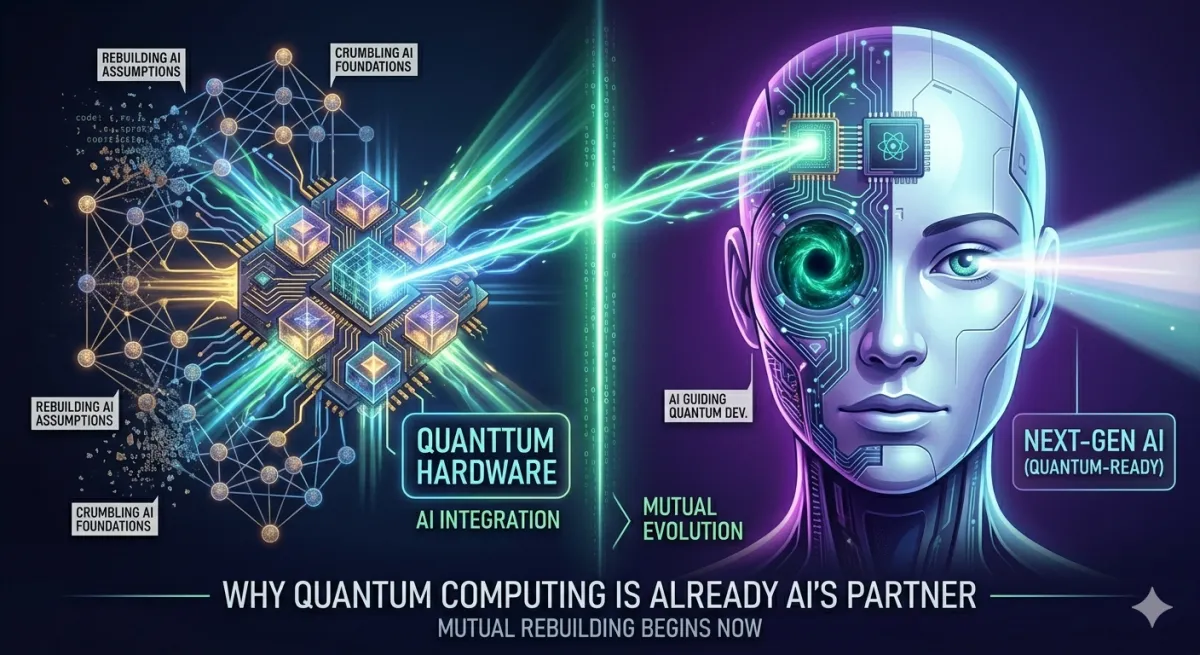
Why Quantum Computing Is More Relevant to AI Than You Think
Most people have filed quantum computing under “interesting but distant.” That instinct is understandable and increasingly wrong. The relationship between quantum hardware and AI is already happening — on both sides of the equation — and the next few years will determine which of today’s AI assumptions have to be rebuilt from scratch.
Emerging Tech | Quantum x AI | Infrastructure | April 2026 ~15 min read
The instinct that’s becoming indefensible
| Milestone | Timeline |
|---|---|
| When Gartner says current encryption breaks | 2034 |
| When Microsoft expects commercial quantum | 2029 |
| Qubits Microsoft aims to fit on one chip | 1,000,000 |
Quantum computing has been “ten years away” for about thirty years. This article will not pretend otherwise. What it will argue is that the relationship between quantum and AI is already active — in both directions — and that the transition from NISQ (noisy intermediate-scale quantum) to fault-tolerant quantum computing has real, concrete implications for AI infrastructure that are worth understanding now, not when it arrives.
The standard narrative about quantum computing goes like this: brilliant technology, genuinely revolutionary potential, but don’t hold your breath because it’s still mostly theoretical and you don’t need to think about it yet. That framing was defensible in 2020. It’s getting less defensible every month.
In the past four months alone: IBM announced it’s on track for verified quantum advantage by the end of 2026. Google demonstrated below-threshold error correction on its Willow chip. Microsoft unveiled the first quantum processor built on topological qubits with a roadmap to a million qubits on a single chip. Amazon launched its Ocelot chip with a cat qubit architecture that could reduce error correction overhead by up to 90%. And — the detail that woke up the security industry this week — new research from Google and a startup called Oratomic, accelerated using AI, suggests that quantum computers capable of breaking internet encryption may arrive considerably earlier than expected.
That last sentence deserves to stop you. AI helping to accelerate the development of quantum computers that can break the encryption protecting AI systems. The loop is already closing.
Two technologies already shaping each other
The usual framing is that quantum computing will eventually help AI. This is true. But it’s only half the story, and the less urgent half right now. What’s happening already is that AI is accelerating quantum development — and quantum’s approaching capability is forcing immediate structural changes in how AI systems are secured.
| AI helping quantum | Quantum threatening AI |
|---|---|
| AI-based error correction and noise modeling | Breaking RSA encryption protecting AI API traffic |
| AI optimizing qubit calibration at the pulse level | Breaking TLS securing model weight transfers |
| AI-assisted algorithm discovery (Oratomic breakthrough) | Destroying cryptographic authentication for AI agents |
| AI generating quantum circuit designs | Forcing post-quantum cryptography across the entire AI stack |
| ML for materials science research in qubit substrates | Accelerating this timeline earlier than expected |
The right column is the one most AI engineers aren’t thinking about. Every API call you make to Claude, GPT-5, or Gemini is currently protected by RSA or elliptic curve cryptography. Your model weights are secured by the same standards. Your authentication tokens, your enterprise AI contracts, your proprietary training data — all of it sits behind cryptographic systems that quantum computers of sufficient scale will be able to break, potentially in hours rather than the millions of years that today’s best supercomputers would require.
Gartner’s projection is that this transition happens by 2034. Cloudflare’s security researchers, responding to the Oratomic paper published this week, called it “a real shock” and accelerated their own internal deadline to prepare for quantum computers to 2029. The U.S. National Institute of Standards and Technology has set a 2035 deadline for transitioning to post-quantum cryptographic standards — and that deadline was set before the Oratomic results.
The Oratomic story: AI closes the loop
The detail that landed hardest this week was the role AI played in the most alarming quantum result yet. A team at a startup called Oratomic, publishing concurrently with Google, used AI in developing their algorithm — and the authors don’t hedge about it. “There is no question that we used AI to accelerate this development,” Dolev Bluvstein, one of the paper’s authors, told TIME. “No question at all.”
The breakthrough suggests that quantum computers capable of breaking internet encryption may arrive sooner than the field’s most optimistic timelines had assumed. AI, apparently, helped get them there faster.
“It’s a real shock. We’ll need to speed up our efforts considerably.” — Bas Westerbaan, Cloudflare cybersecurity researcher, April 2026
Cloudflare’s response — moving their internal post-quantum deadline to 2029 — is the right one. But it also reveals how much of the infrastructure underpinning the AI economy is quietly running on cryptographic assumptions that are on a countdown timer. The AI industry is building on top of encryption that it may have to replace entirely within five to ten years, and the timeline is being compressed by the very AI tools it’s simultaneously deploying.
The hardware race, explained honestly
There are currently four fundamentally different approaches to building quantum computers, each with different tradeoffs, backed by major technology companies. Understanding which approach wins — and when — matters enormously for AI infrastructure planning.
| Approach | Company | Key Hardware | Status |
|---|---|---|---|
| Superconducting transmon qubits | Google / IBM | Google Willow (105 qubits), IBM Condor (1,121 qubits) | Most mature. Below-threshold error correction achieved. Both targeting fault tolerance by 2029. |
| Topological qubits | Microsoft | Majorana 1 (8 qubits, prototype) | Different physics — stores info in topology itself. Roadmap claims path to 1M qubits on a single chip. Error rates hardware-protected by design. |
| Cat qubits | Amazon | Ocelot chip (Feb 2025) | Middle path. Inherently resistant to certain error types. Claims 90% reduction in error correction resources vs standard transmons. |
The honest assessment is that no approach has definitively won. IBM and Google have scale and manufacturing expertise but face real limits on how many physical qubits are needed for fault tolerance. Microsoft has the most elegant theory but Majorana 1 has only 8 qubits and the company’s Nature paper admits it hasn’t fully proven the existence of the Majorana particles it’s using. Amazon’s cat qubits are a genuine innovation in error correction efficiency but remain experimental.
What matters for AI practitioners is the convergence of the roadmaps: IBM expects verified quantum advantage by end of 2026. Microsoft projects commercial quantum computers in data centers by 2029. The industry consensus on fault-tolerant, commercially useful quantum computing lands somewhere between 2028 and 2032. That’s not “decades away.” That’s within the planning horizon of every enterprise AI deployment being made right now.
The part that matters for AI training
Here is the less urgent but genuinely transformative long-term story: quantum computers are particularly well-suited to several of the most computationally expensive operations in modern AI.
Large language model training is, at its core, a massive optimization problem run on matrix multiplications. The specific bottlenecks — finding optimal parameter configurations in high-dimensional spaces, sampling from complex distributions, simulating molecular interactions for AI-accelerated drug discovery — are exactly the classes of problems where quantum speedups are theoretically most significant.
Now — 2026: Hybrid quantum-classical models. Classical GPUs handle bulk training and inference. Quantum processors tackle specialized optimization subroutines where quantum advantages are already present in NISQ-era hardware. AI-accelerated quantum error correction is improving qubit stability in parallel.
2027 — 2030: Quantum co-processors in AI data centers. IBM, Google, and Microsoft all have roadmaps pointing toward quantum processors joining GPUs and TPUs in cloud AI infrastructure. Early fault-tolerant systems tackle the specific optimization problems that classical hardware handles inefficiently at scale. Post-quantum cryptography transition begins in earnest across the AI stack.
2030 — 2035: Quantum advantage for AI-relevant tasks. Error-corrected quantum computers begin demonstrating genuine speedups on optimization problems that matter for AI: training time reduction, molecular simulation for AI-accelerated science, quantum machine learning for high-dimensional datasets. The encryption transition is either complete or the vulnerabilities are actively being exploited.
Beyond 2035: Genuine quantum AI systems. End-to-end quantum AI — models running on quantum hardware, not just classical models accelerated by quantum subroutines — remains largely theoretical even in 2026. This is the long game. The shorter game is hybrid systems and the cryptographic transition.
The IBM-ETH Zurich 10-year collaboration announced on March 31, 2026 is a clear signal of where serious institutions are placing their bets. The initiative focuses specifically on new algorithmic paradigms at the intersection of AI and quantum systems — optimization and combinatorial problems, differential equations, linear algebra, complex system modeling. These are not abstract research topics. They are the mathematical foundations of modern AI at scale, and the institutions that figure out how to run them efficiently on hybrid quantum-classical hardware will have a meaningful advantage.
What AI is doing for quantum — right now
The direction that gets less press is AI accelerating quantum development. It’s happening in several concrete ways.
Error correction. This is the central unsolved challenge in quantum computing. Qubits are fragile. Stray electromagnetic fields, temperature fluctuations, even cosmic rays can flip a qubit’s state mid-computation. Current quantum computers spend much of their resource budget correcting errors rather than doing useful work. AI-based error correction — machine learning models trained on quantum hardware behavior — is proving more effective than hand-designed correction algorithms at compensating for noise patterns. Researchers describe this as AI doing for quantum error correction what it did for protein folding: discovering patterns in a complex system that humans hadn’t found through analytical approaches.
Pulse-level calibration. Every qubit in a quantum processor has slightly different physical characteristics — resonant frequencies, coupling strengths, decay times — that drift over time as the hardware ages and temperature fluctuates. Manually re-calibrating a system with hundreds of qubits is impossibly labor-intensive. AI models that learn the hardware’s behavior and automatically re-tune the control pulses are becoming standard practice at IBM and Google’s quantum research groups.
Algorithm discovery. The Oratomic result — using AI to discover new quantum algorithms faster. This is the most significant long-term development because algorithm efficiency matters as much as hardware quality. A better algorithm running on the same hardware can be worth as many qubits as a hardware generation upgrade. If AI can discover better quantum algorithms at the same rate it’s been discovering better protein structures, the effective capability of quantum hardware accelerates faster than the hardware roadmaps alone would suggest.
The locksmith problem, again
If Mythos — Anthropic’s new AI model discussed this week — is the “locksmith problem” for cybersecurity (a model so capable of finding and exploiting vulnerabilities that it couldn’t be safely released), then quantum computing is the locksmith problem for cryptography. The same physics that makes a quantum computer useful for optimization makes it capable of factoring the large prime numbers that underlie RSA encryption. The same Shor’s algorithm that could help AI systems explore optimization landscapes could also break the authentication tokens protecting AI API access.
The NIST post-quantum cryptography standards, finalized in 2024, represent the field’s response. They define a set of cryptographic algorithms believed to be resistant to quantum attack — based on mathematical problems that even quantum computers struggle with, like learning with errors (LWE) and hash-based signatures. Migrating to these standards is not a software update. It’s a multi-year infrastructure overhaul affecting every system that handles encrypted data, which in a world where AI is deeply embedded in enterprise infrastructure, means essentially everything.
If quantum computers capable of breaking current encryption arrive by 2029-2034 (the range that serious institutions are now planning for), and if the full post-quantum cryptography migration takes 5-7 years (a reasonable estimate for large enterprise systems), then organizations need to begin their crypto migration planning now. Hybrid AI deployments being architected today need to either already use post-quantum-resistant algorithms or include a clear migration path. This is not a future concern. It’s a current architectural decision.
The honest case for caring now
Let’s be direct about what “quantum computing is relevant to AI” does and doesn’t mean in April 2026.
It does not mean that quantum computers are going to replace GPUs for AI training in the near term. Classical deep learning is not going anywhere. The massive ecosystem of PyTorch, CUDA, and cloud GPU infrastructure is decades from becoming obsolete, and even in a world with fault-tolerant quantum computers, hybrid systems are the realistic near-term architecture.
It does not mean you need to start learning quantum programming today. The tooling, the algorithms, and the hardware are all still maturing. Organizations experimenting now do gain a head start in talent and infrastructure intuition, but “learn the Qiskit API” is not the urgent action item for most AI practitioners.
What it does mean:
The cryptographic foundations of the entire AI economy are on a countdown timer. Every AI system handling sensitive data — model weights, proprietary training data, enterprise API calls, authentication for AI agents — needs a post-quantum migration plan. That plan needs to start now because the migration itself takes years, and the timeline for when it becomes necessary is compressing in ways that even optimistic security researchers weren’t expecting last month.
The optimization problems that constrain AI development — training efficiency, energy consumption, model search — are the exact class of problems where quantum hardware offers its most significant theoretical advantages. As fault-tolerant systems come online between 2028 and 2032, the organizations that have been developing quantum-enhanced optimization workflows will have a real advantage in training efficiency and therefore in model capability.
And AI itself is accelerating quantum development in ways that will shorten every existing timeline. The Oratomic result is the clearest demonstration yet: AI isn’t just going to benefit from quantum computing. It’s actively helping build it. The loop between the two technologies is already running, and the outputs are accelerating on both sides.
AI is helping quantum computers arrive sooner. Quantum computers are threatening the encryption protecting AI systems. The two technologies are not on parallel tracks — they’re already entangled.
Where to pay attention in the next 24 months
IBM’s 2026 quantum advantage demonstration is the first major milestone to watch. If they deliver verified quantum advantage — a quantum computer solving a meaningful problem faster than any classical alternative — it marks the transition from “quantum computing demonstrates interesting physics” to “quantum computing solves real problems.” The specific problems IBM is targeting are optimization and simulation tasks directly relevant to AI workloads.
The post-quantum cryptography migration at the infrastructure layer is the second. NIST’s finalized standards exist. The tooling exists. What’s lagging is enterprise adoption — the actual work of updating TLS configurations, API authentication, certificate infrastructure, and model serving systems to use post-quantum-resistant algorithms. When hyperscalers and major cloud providers start requiring post-quantum-compliant implementations (and they will, probably before 2030), every AI system built on top of their infrastructure will need to comply.
Microsoft’s Majorana roadmap is the third. If topological qubits scale as Microsoft claims — a genuinely big “if” — the implications for qubit counts and therefore for the problems quantum computers can practically address would be transformative. Eight qubits today to a million on a single chip represents a different order of possibility. The physics might not cooperate. But Microsoft’s DARPA selection for the utility-scale fault-tolerant quantum computing program suggests the scientific community takes the approach seriously enough to fund it at the national level.
If you’re building or operating AI systems that handle sensitive data, initiate a post-quantum cryptography audit. Inventory every cryptographic primitive in your stack — TLS configurations, API authentication, data encryption, model weight storage. Map each one to a post-quantum alternative. Then build a migration timeline. You have time, but less than you had last month, and the clock is being moved forward by the same AI tools you’re using to build the systems that need protecting.
The bottom line
Quantum computing has been the perennial “not yet” story of technology. The prediction has been reliably wrong in one direction — the skeptics have consistently been more right than the optimists, and that’s worth remembering when evaluating any specific timeline. Fault-tolerant quantum computers may arrive later than 2032. They may hit unexpected physics walls. Microsoft’s topological qubits may not scale as claimed.
But the relationship between quantum and AI isn’t waiting for fault-tolerant hardware. AI is already helping build better quantum computers. Quantum’s approaching capability is already forcing an encryption migration. The algorithmic foundations for hybrid quantum-classical AI are already being developed at IBM, ETH Zurich, and dozens of other institutions. And the timeline for when quantum computers become genuinely dangerous to current cryptographic infrastructure just moved earlier, because AI helped a startup discover a better algorithm.
The instinct to file this under “interesting but distant” is getting harder to justify every quarter. This story is no longer about what quantum computing will do to AI. It’s about what’s already happening between them, right now.
Sources
- TIME — AI accelerates quantum encryption breakthrough, April 7, 2026 (Oratomic / Google research)
- IBM / Programming Helper — Quantum advantage target, January 2026
- Microsoft Source — Majorana 1 announcement, February 2025
- Dataconomy — Microsoft commercial timeline (2029), February 2026
- IBM Newsroom — IBM-ETH Zurich 10-year collaboration, March 31, 2026
- IEEE Standards — Gartner encryption timeline, February 2026
- PostQuantum.com — Quantum hardware comparison
- FINOS / Moody’s — Amazon Ocelot chip analysis
If you want to understand the distributed systems and cryptographic foundations that quantum computing is about to reshape, Designing Data-Intensive Applications by Martin Kleppmann covers the encoding, replication, and storage principles that underpin the infrastructure now facing a post-quantum migration.
Disclaimer: This article is based on publicly available research, company announcements, and verified reporting as of April 9, 2026. The author has no affiliation with any of the companies or research institutions mentioned. Quantum computing timelines are inherently speculative and have historically been more optimistic than accurate. The commercial and fault-tolerance targets cited here are from company roadmaps and analyst projections, not guarantees. The Oratomic research is recent and has not yet been independently replicated at the time of writing. This article contains affiliate links — purchasing through them supports this blog at no extra cost to you.

Comments
Loading comments...