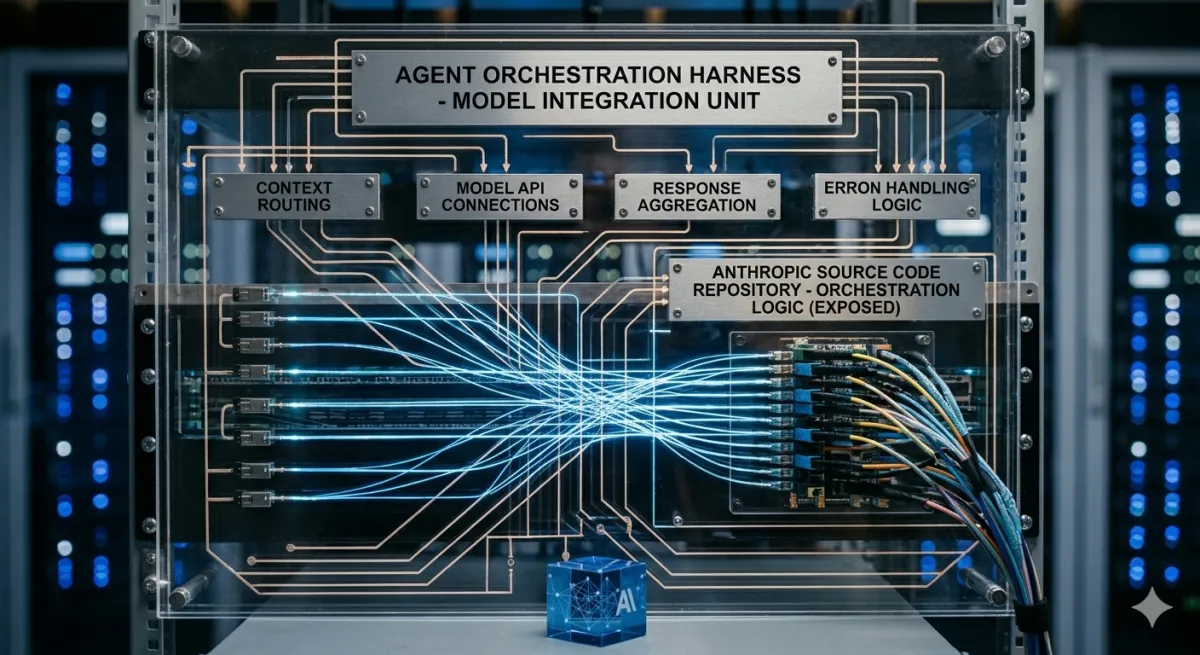
The Agent Harness Is the Real Product, Not the Model
In March 2026, a packaging error exposed 512,000 lines of Anthropic’s source code. What it revealed wasn’t the model. It was the orchestration layer — and it changed how the industry thinks about where AI value actually lives.
Architecture | Agentic AI | Claude Code | April 2026 ~14 min read
The leak that changed how engineers think about AI products
Here’s the thing that hit engineers hardest when the Claude Code source leaked: it wasn’t that the model was doing something surprising. It was that the model was doing almost nothing on its own.
What the 512,000 lines of TypeScript revealed was a sophisticated orchestration system — permission layers, memory tiers, context management loops, recovery strategies, tool routing — built around a model that the harness treated like a smart-but-constrained subprocess. The intelligence wasn’t in the weights. The intelligence was in the machinery built to shape what the weights saw, what they were allowed to do, and what happened when they got it wrong.
One analysis framed it immediately: the harness is where the real product lives. Not the model. The harness.
| Metric | Value |
|---|---|
| Lines of TypeScript leaked | 512,000 |
| Permission-gated tools in harness | 19 |
| Memory tiers in Claude Code | 3 |
That’s the thesis of this article. Not that models don’t matter — they do, and they’re improving fast. But once you cross a basic capability threshold, the model becomes increasingly interchangeable. What differentiates a demo from a deployable system is the scaffolding wrapped around it: tools, memory, safety, evals, and orchestration. That’s the moat. That’s the product.
The leak occurred on March 31, 2026 when Anthropic accidentally shipped a source map in @anthropic-ai/claude-code v2.1.88. Anthropic confirmed it as a packaging error. No customer data was compromised and Anthropic issued DMCA notices. The architectural details discussed here were widely analyzed by the community before takedowns. All technical claims are attributed to published post-mortems and community analyses — not the leaked code itself.
What the Claude Code leak actually showed
The architectural details that emerged from community analysis tell a clear story about what production-grade agent engineering actually involves. The harness wasn’t a thin wrapper around prompts. It was an operating system for the model.
Permission engine — Three-tier approval system: auto-approve safe actions, auto-mode classifier for ambiguous ones, mandatory human confirmation for anything destructive. The classifier sees the tool call but not the model’s prose — a deliberate choice to prevent the model from sweet-talking its way past the gate.
Tool layer — ~19 permission-gated tools across file I/O, shell execution, Git operations, web scraping, and notebook editing. Opinionated, validated tools run in concurrency-safe batches — not raw shell access, which is noisy and dangerous.
Memory architecture — Three tiers: a lightweight MEMORY.md index (~150 chars per entry, always loaded), on-demand topic files, and raw transcripts accessed via search only. The index stores locations, not data. “Self-healing memory” with strict write discipline prevents context pollution from failed attempts.
Context management — The query loop dynamically compacts messages, silently injects resume instructions when output budgets run out mid-task, and steps through recovery strategies on tool failure — all without surfacing failures to the user.
Session continuity — A background daemon (autoDream) wakes after 24 hours of inactivity and at least five sessions. It reads the project’s memory directory, consolidates learnings, deletes contradictions, and rewrites the memory index. Sleep-based memory consolidation, modeled on how humans solidify knowledge overnight.
CLAUDE.md anchor — A persistent project-level config loaded at session start. Build commands, test commands, architecture rules, naming conventions, coding standards. Survives context compression. Without it, every session starts blank and the agent makes the same mistakes in session five it made in session one.
Not one of these components is a model capability. All of them are engineering decisions about what the model sees, what it’s allowed to do, and how failures get absorbed before they reach the user.
“A raw LLM is a CPU with no RAM, no disk, and no I/O. The harness is the operating system. The agent is the emergent behavior the OS produces.” — Beren Millidge, adapted in community analysis of the Claude Code architecture
The capability threshold argument
The counterargument is obvious: if the model were much better, you’d need less scaffolding. True. But we’ve been at “good enough to build serious things on” for at least two years, and the scaffolding problem hasn’t gone away — it’s gotten more complex. Better models surface new failure modes. A model that can reason over long contexts still needs context management. A model that rarely hallucinates still needs output validation before its results touch a database.
The threshold isn’t a ceiling on model capability. It’s a floor on what makes a system production-worthy regardless of model capability. Above that floor, both things matter — but they compound differently. Model improvements are additive. Harness improvements are multiplicative, because they change what fraction of the model’s capability actually reaches users reliably.
| What the model gives you | What the harness gives you |
|---|---|
| Reasoning quality on individual calls | Reliable tool execution at scale |
| Benchmark performance | Session continuity across restarts |
| Context window size | Safety that the model can’t override |
| Instruction following accuracy | Recovery from failures users never see |
| Multimodal capabilities | Context quality across long sessions |
Swap the model — Sonnet to Opus, Claude to GPT — and you change the reasoning quality per call. Swap the harness — permission model, memory tiers, context management — and you change whether the system works at all for production workloads. Both matter. But one is a dial, and one is a switch.
Safety that the model can’t override
This is the underappreciated design principle that Claude Code’s architecture made explicit: separate reasoning from permission enforcement.
The model decides what it wants to do. A different code path — deterministic, classifier-based, not a language model — decides whether it’s allowed. A jailbroken model can’t bypass the safety checks because it literally cannot reach the permission layer. The architecture doesn’t trust the model’s judgment about its own permissions.
In practice:
# Claude Code's three-tier permission model (from community analysis)

# Tier 1 -- Auto-approved: read-only, no state change
file_read(), text_search(), code_navigate()

# Tier 2 -- Auto-mode classifier: evaluates risk before proceeding
# Classifier sees: (user request, tool call)
# Classifier does NOT see: model's prose reasoning
# This prevents the model from arguing its way past the gate
file_edit(), shell_command(low_risk=True)

# Tier 3 -- Always prompt human
shell_command(destructive=True)
git_push(), deploy(), delete_production_data()
The critical insight: the auto-mode classifier is running on a separate Sonnet 4.6 instance. It evaluates the tool call before execution. The main model — which produced the tool call — has no ability to influence whether the classifier approves it. If the main model were compromised, the permission layer would still hold.
This is safety architecture, not prompt engineering. “Don’t do harmful things” in a system prompt is a suggestion. A separate permission enforcement path that doesn’t read the model’s reasoning is a constraint. The difference matters enormously in production.
Memory: where most agents fail silently
Context rot is the quiet killer of production agents. When key content falls in mid-window positions, model performance degrades measurably — one practitioner analysis puts it at 30%+ quality degradation on tasks requiring recall of earlier context. Most hobby agent implementations treat context as a bottomless bag. It’s not.
Claude Code’s three-tier memory system was designed specifically around this failure mode:
Tier 1 — Hot index. MEMORY.md: ~150 characters per entry, always in context. Stores pointers, not data. “Auth module is in /src/auth/service.ts, last modified to fix rate limiting bug” — not the file contents themselves.
Tier 2 — Warm files. Topic files fetched on-demand. If the task involves auth, the auth topic file loads. If it doesn’t, it stays on disk. Just-in-time retrieval instead of loading everything up front.
Tier 3 — Cold transcripts. Raw session transcripts never re-read into context. Accessed via grep for specific identifiers only. This keeps the cold tier from exploding context with irrelevant history.
The strict write discipline — agents must update the index only after a confirmed file write — prevents a subtle failure mode: the model marking something as known when the write actually failed. Context pollution from failed attempts is insidious because the model confidently acts on information that doesn’t reflect disk state.
Evals as a first-class harness component
Claude Code has a clean feedback loop that most domains don’t: code either compiles or it doesn’t. Tests pass or they fail. A linter approves or flags. These are deterministic checks the harness can run automatically on every output. The model’s work can be evaluated without human judgment on every single change.
This is why harness quality varies so much across domains. In software engineering, the feedback signal is fast and deterministic. In customer support, content generation, or healthcare, it isn’t. Building a harness for those domains requires designing evaluation feedback loops from scratch — which is most of the engineering work.
Anthropic’s self-evaluation capability in Managed Agents (in research preview) is an attempt to generalize this: let the model define success criteria and iterate toward them. Whether that works reliably outside of domains with clean feedback signals remains to be seen. But the architectural commitment is clear: evals are infrastructure, not an afterthought.
Production harness engineering covers eleven distinct components — the reasoning loop, tool layer, memory system, context assembly, permission model, error handling, session management, output validation, eval pipeline, observability, and lifecycle hooks. Most agent demos implement one or two of these. Most production failures happen in the others.
Orchestration: the last frontier
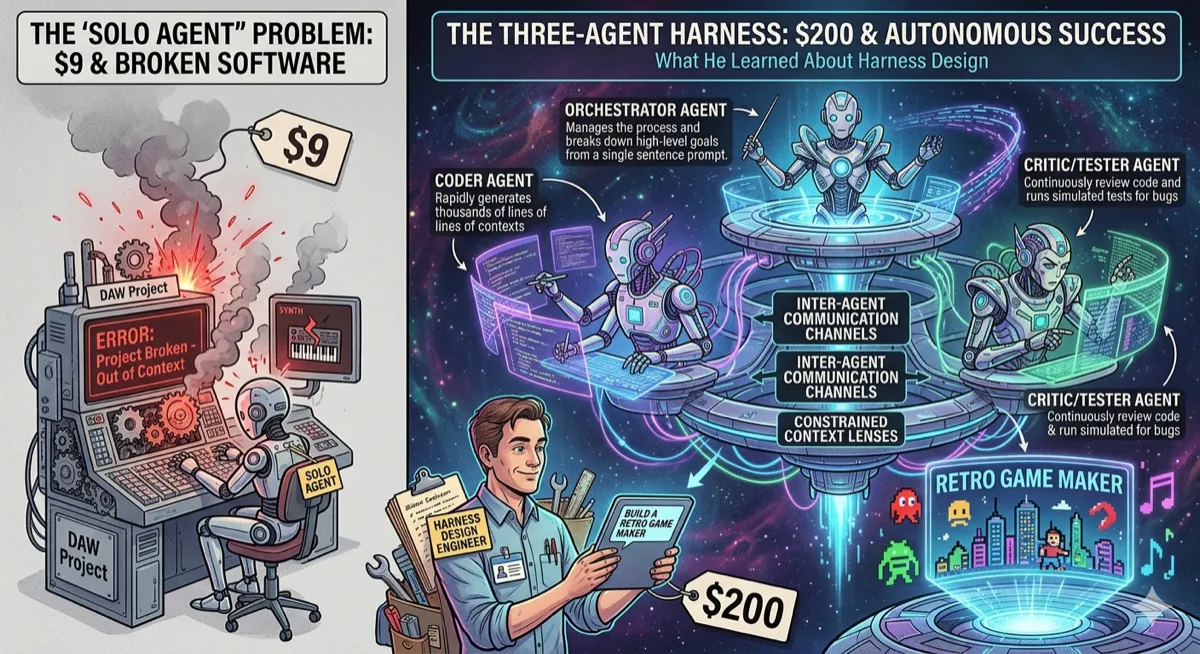
Multi-agent orchestration is where harness engineering gets genuinely hard. It’s not about routing a task to one of two specialists. It’s about managing a fleet of agents with overlapping context, shared state, competing tool access, and failure modes that compound unpredictably.
Claude Code’s approach, as revealed in the leak and confirmed in documentation, uses a conductor pattern: a primary agent delegates to subagents, each of which explores extensively and returns condensed 1,000-2,000 token summaries rather than dumping full context back up the chain. The information hierarchy prevents context explosion at the orchestration level.
The community immediately saw what this made possible. The Citadel project — built on top of Claude Code within days of the leak — implements parallel agents in isolated git worktrees, a discovery relay between waves, circuit breakers for failure spirals, and campaign persistence that survives context compression. One person, four days, a production-grade multi-agent orchestration system. The harness patterns from the leak were that directly applicable.
And one person — Korean developer Sigrid Jin — rewrote the core agent harness from scratch by sunrise. No copied code. Clean-room reimplementation using AI tools. That repo hit 100K stars in 24 hours, the fastest in GitHub history. The meta story: AI tools used to reverse-engineer AI tooling overnight, by a single person, because the architecture was visible and the implementation tools were good enough.
The moat question
If the harness is the product, and the harness can be reverse-engineered and reimplemented overnight, where’s the moat?
Anthropic’s answer is co-design. The context entropy system — the memory tiers, the compaction strategies, the tool search mechanism — was designed alongside the models it orchestrates. A community-built clone has the blueprints. It doesn’t have the 18 months of iteration that shaped those blueprints around how Claude specifically reasons, where it loses thread, and what kinds of context signals it responds to most reliably.
That’s a real advantage. It’s not permanent. It narrows as the community experiments. But it explains why Anthropic’s internal tests show +10 points on structured file generation tasks for Managed Agents versus standard prompting: the harness was designed to work with Claude, not just around it.
“Replicating the architecture without the co-design is like having the blueprints for a Formula 1 car but fitting it with a different engine. Whether that matters depends on how good the alternative engines get. And they’re getting good fast.” — Independent analysis, March 2026
The broader implication for builders: if you’re building an agent product, the model you choose matters less than you probably think, and the harness matters more. Switching models is a one-line config change. Rebuilding a permission model, a memory architecture, and a context management system that actually works in production is months of work. Build the harness first. Swap models to taste.
Where this thesis falls short
The harness-over-model argument has limits worth naming.
First, it assumes a capability threshold that’s already been crossed. For genuinely novel capabilities — real-time multimodal reasoning, very long-context understanding, scientific reasoning — the model still matters decisively. The harness amplifies what the model can do. If the model can’t do it at all, the harness can’t fix that.
Second, the “reimplemented overnight” story cuts both ways. If harness patterns are replicable, the moat for harness builders is narrower than it looks. The co-design advantage is real but temporal. As open-source agent frameworks mature and models become more capable at self-orchestration, the value of proprietary harnesses may compress.
Third, this analysis is heavily weighted toward software engineering use cases where feedback signals are clean and deterministic. Domains without those signals — legal review, medical reasoning, creative work — need fundamentally different harness patterns that haven’t been proven at scale yet.
The bottom line
The Claude Code leak was an ops failure. The intellectual property damage was real, and Anthropic was right to issue DMCA notices. But the architectural revelation it produced has already changed how engineers think about AI products. The model is the engine. The harness is the car. Nobody ships an engine without a car. And nobody wins a race in a good engine with bad chassis.
Sources
- WaveSpeedAI — Claude Code architecture analysis, April 2026
- TechTalks / Ben Dickson — Harness engineering deep dive, April 2026
- Productboard — Product manager perspective, April 2026
- Generative Programmer — 12 harness patterns, April 2026
- VentureBeat — Memory architecture analysis, March 2026
- Daily Dose of DS — Anatomy of a harness, April 2026
Related articles
- The Harness Is Everything — the foundational argument for why environment design trumps model selection
- Claude Code Source Leak: 512K Lines Exposed — the incident that made this architecture public
- Claude Code’s /ultraplan — the planning feature hidden in the leaked source
- AutoAgent: The AI That Engineers Its Own Harness — what happens when agents design their own harnesses
If you want to go deeper on the architectural patterns behind building reliable AI systems — orchestration, state management, fault tolerance, and the engineering that makes production infrastructure work — Designing Data-Intensive Applications by Martin Kleppmann covers the foundational principles that transfer directly to agentic AI infrastructure.
Disclaimer: This article is based on published post-mortems and community analyses of the March 2026 Claude Code leak. The author has no affiliation with Anthropic beyond being a user of Claude. Anthropic has issued DMCA notices for direct code reproduction — this article discusses architectural patterns, not proprietary code. All technical claims are attributed to independent community analysis. The 512K line count, 19-tool count, and 3-tier memory figures are from community analysis of the exposed codebase, not official Anthropic disclosures. This article contains affiliate links — purchasing through them supports this blog at no extra cost to you.
Comments
Loading comments...